"Going back to Excel would be absolutely time-wasting compared to what's available with Aphex. More importantly, it would take me away from solving problems with the team. I’d definitely recommend Aphex to all my peers.”

%20-%20Grey.svg)
On complex projects, trades often need to work alongside one another in tight spaces. Even at the best of times, this creates major coordination headaches.
When coordination systems fail, the results are predictable: trades clash on site, work gets delayed, and managers spend their time putting out fires instead of preventing them.
Built Environs knew they needed to solve this problem in advance when working on a complex build project. The process building for this project spans four levels, with a height comparable to an eight-story apartment block, and features intricate roof structures and complex service installations. Multiple service trades are needed to work simultaneously in intricate spaces with complex sequencing requirements.
We spoke with Rokini Seruvakula, Built Environs' Site Manager, about how his team transformed their coordination approach to eliminate conflicts before they occurred, while dramatically reducing planning overhead.
The challenge
Traditional coordination approaches can break down when projects involve multiple trades working in interfacing spaces. Potential issue include:
- Communication lag between actual work and planning updates.
Traditional weekly planning cycles create information gaps that lead to coordination failures. When work doesn't go according to plan on Tuesday and the next update isn't until Friday, other trades continue working with outdated information.
- Complex trade coordination and sequencing.
Multiple trades working in the same area without proper sequencing creates safety risks and productivity losses that require constant manual intervention to resolve.
- Expectation management with subcontractors.
Subcontractors often interpret schedule dates as fixed commitments rather than targets with built-in contingencies. This creates frustration when dates shift and makes it difficult to maintain collaborative relationships across the project team.
How did the Built Environs team avoid these common pitfalls?

Build transparency into coordination routines
Built Environs worked to radically reduce the administrative burden of planning while providing all stakeholders with up-to-date, actionable information on project coordination.
Their key insight is that most coordination problems stem from information delays rather than fundamental scheduling conflicts. By providing real-time visibility into what's happening across all trades, better coordination happens without extensive manual intervention.
Subcontractors can see the full project context, including what other trades are doing, when spaces become available, and how their work impacts others. This means they naturally coordinate more effectively.
The trades hold each other accountable. They all can see the direction. They all know the goal, so they can see where to focus and anticipate pinch points. To improve sequencing and sharpen program focus, the more information, the better.
Rokini Seruvakula, Senior Site Manager
Solution 1: Create a routine of daily progress recording
The Built Environs team implemented daily progress recording, providing immediate visibility into coordination issues.
Instead of waiting for scheduled meetings, Rokini established routine morning and afternoon site walks, during which he records progress immediately using mobile technology. Critical issues automatically escalate to project management, while routine progress flows into project systems without requiring separate reporting.
This approach eliminated the redundant conversations that consume management time. Rather than spending hours in weekly catch-ups explaining what happened on site, project managers gain real-time visibility into project progress and can focus on issues requiring intervention.
The system builds accountability into daily workflows. Subcontractors know their progress is visible immediately, and project managers can intervene when issues arise rather than discovering problems days later in formal meetings.
How to implement with Aphex
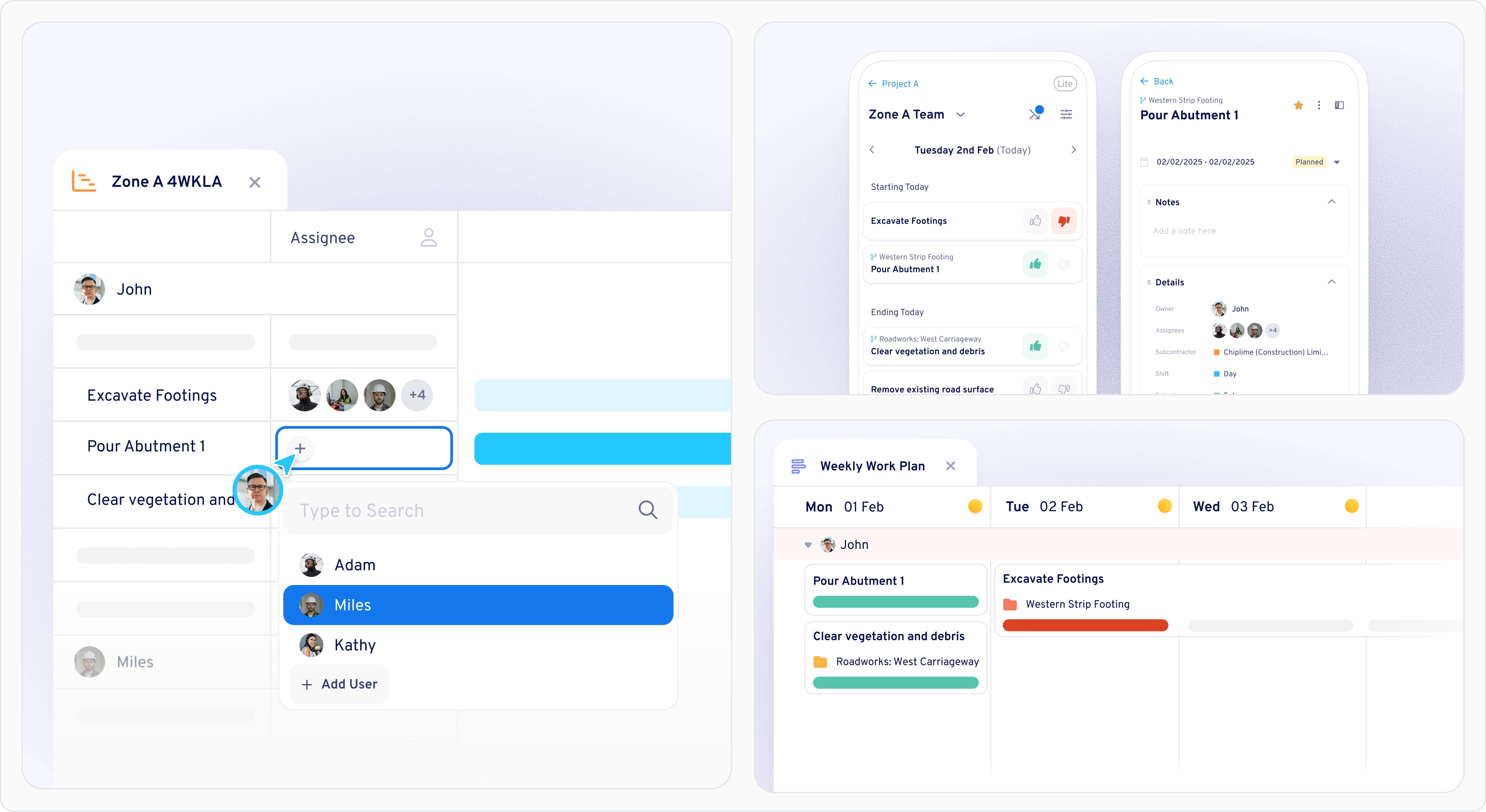
Set up a simple daily routine using Aphex's mobile app to record progress on-site. Train your team to use the thumbs-up/thumbs-down status indicators during regular site walks—typically once in the morning to confirm planned work and once in the afternoon to capture any changes.
This creates an immediate feedback loop that keeps everyone working from current information. Instead of waiting for formal progress meetings, stakeholders can see coordination issues as they emerge and make real-time adjustments to their own work plans.
I use the Aphex app in the morning and afternoon and update tasks with a simple thumbs up/down. It updates the team automatically and minimises repetitive conversations.
Rokini Seruvakula, Senior Site Manager
Solution 2: Use visual coordination to prevent trade conflicts
The Built Environs team used visual planning to identify where trades would be working and prevent conflicts before they occurred on site. They mapped work zones for different activities directly on the site plan. When activities overlapped, potential clashes became immediately visible, prompting early discussions.
The key insight is that most coordination conflicts are predictable if you systematically visualise work areas. Rather than hoping trades will resolve space conflicts on their own, the system identifies overlaps and prompts discussions before work begins.
The approach was pragmatic. The team focused on making conflicts obvious early enough to resolve them through conversation rather than scrambling to fix problems later.
We’ve got many different intersecting trades on this project, which means we need to avoid conflicts during planning. It’s easy to put too many people in a large space if you don’t carefully map out works ahead of time.
Rokini Seruvakula, Senior Site Manager
How to implement with Aphex: Work area mapping
Import your site layout into Aphex to create an accurate base map that all stakeholders can reference. Link planned tasks to specific locations on the map to visually connect your schedule to physical work areas.
Use Aphex's work area overlay feature to mark out zones for different activities directly on your site map. When you schedule activities in overlapping areas, the system automatically highlights these clashes, prompting your team to discuss sequencing and coordination options.
This replaces the need for separate coordination meetings focused solely on spatial conflicts. Instead, conflicts become visible during normal planning activities, making coordination a natural part of the scheduling process rather than a separate administrative burden.
When I’m drawing work areas, Aphex automatically points out potential clashes. The software helps you map where work is happening so you don't overlap trades. And if something's falling behind, it'll show how it can impact future works.
Rokini Seruvakula, Senior Site Manager
.webp)
The results: Improved project performance while reducing coordination overhead
Built Environs' approach delivered measurable improvements in both efficiency and project coordination across multiple dimensions of project performance. Specific results include:
- Faster planning routines. The team reduced weekly planning time and eliminated duplicate administrative systems. This created a single source of truth for all project coordination.
- No space conflicts on site. Zero coordination conflicts occurred between trades during the project, with immediate visibility into schedule changes for all stakeholders. Transparent information simplified expectation management with subcontractors.
- More effective trade coordination. Subcontractors could see what other trades were doing, when spaces became available, and how their work impacted others. With full project visibility, trades held each other accountable and anticipated coordination issues before they arose.
Going back to Excel would be absolutely time-wasting compared to what's available with Aphex. More importantly, it would take me away from solving problems with the team. I’d definitely recommend Aphex to all my peers.
Rokini Seruvakula, Senior Site Manager
What you can apply: Four principles for coordination in complex build projects
- Replace reactive meetings with proactive communication systems. Traditional weekly meetings consume management time while providing outdated information. Integrate progress recording into daily site routines using simple mobile tools that provide real-time visibility without creating administrative overhead.
- Make conflicts visible before they impact the site. Most coordination problems are predictable if you systematically visualize work areas and timing relationships. Invest in simple mapping tools that surface conflicts during planning rather than discovering them when trades clash on site.
- Create transparency that allows for self-coordination. When subcontractors understand the broader project context and can see how their work impacts others, they coordinate more effectively without requiring constant management intervention. Share comprehensive project information rather than keeping trades in information silos.
- Design systems that reduce rather than increase administrative burden. Coordination systems should free up management time for problem-solving, not create more administrative work. Choose approaches that integrate naturally into existing site management routines rather than requiring separate planning processes.
%20-%20White.svg)
Heading
Lorem ipsum dolor sit amet, consectetur adipiscing elit. Suspendisse varius Duis cursus,



.webp)