
With Aphex, the younger engineers can now update the program themselves, which frees up the people above them to focus on delivery.


Major infrastructure projects often involve work across multiple locations, each with its own technical challenges. This problem intensifies in rail corridors, where access windows are measured in hours rather than days, and missing a possession means waiting weeks for the next opportunity.
When design changes and scope variations are added, teams face a coordination challenge that traditional planning methods struggle to handle.
To learn more, we spoke with Senior Project Manager Andrew Ford and Project Manager Andrew Wiadrowski from the Martinus team on Sydney Metro Southwest about how they maintained delivery certainty across fifteen bridge locations while managing these coordination challenges.
The Sydney Metro Southwest project
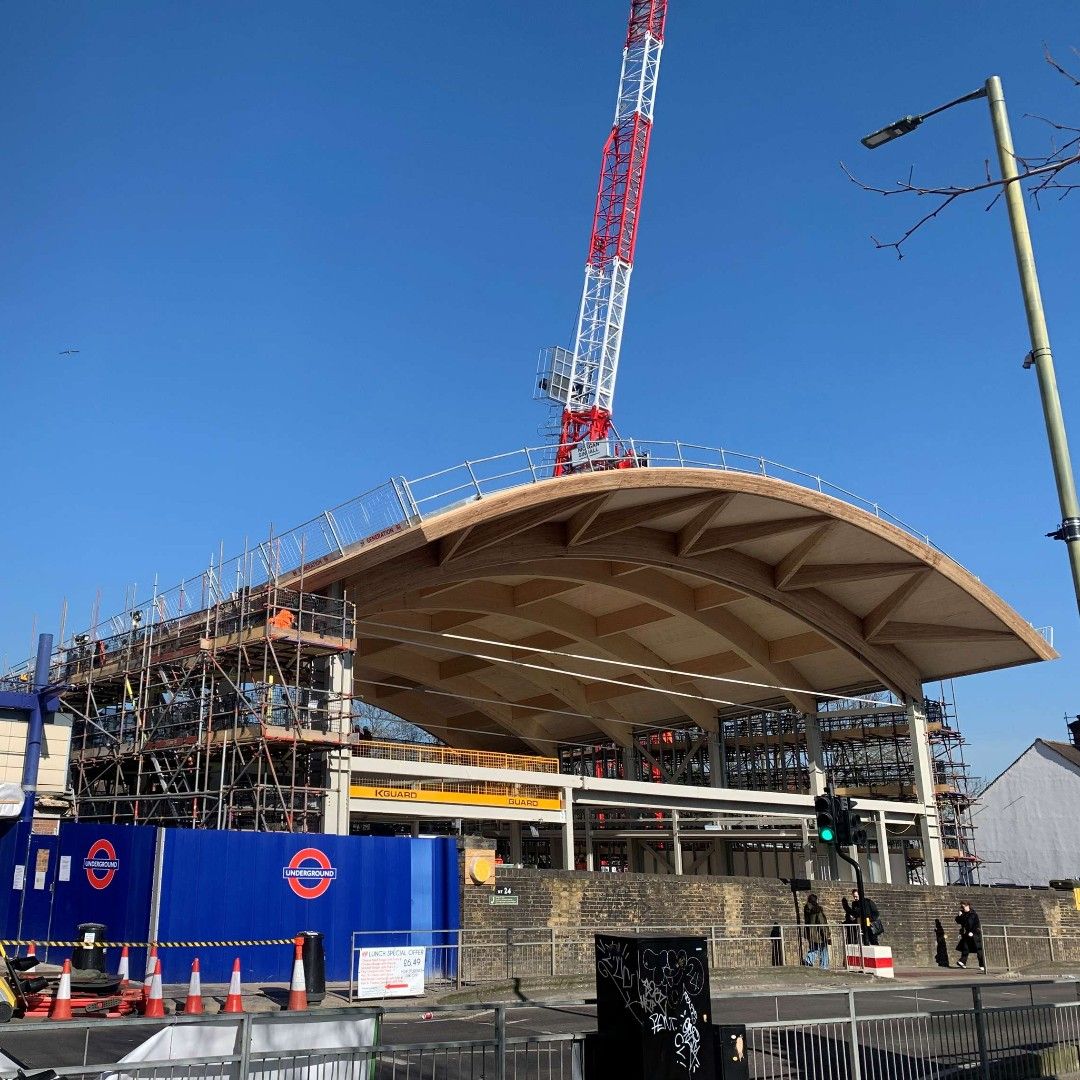
Martinus serves as head contractor for the Sydney Metro Southwest Metro Conversion and Station Works Package 4, responsible for upgrading rail infrastructure to accommodate driverless metro operations.
The project includes:
- Errant and hostile vehicle treatments to 15 road-over-rail bridges, including upgrades to existing barriers, new guardrails, walls, and retaining structures.
- Additional fencing, finishing, and streetscaping works across over 60 non-bridge locations along the rail corridor
- Road upgrades, including kerbside ramps and traffic signalling at Wiley Park, to improve access and safety for road users.
The project operates under significant constraints: work occurs around live rail operations, requiring carefully planned possessions; lengthy lead road authority approvals; 12-week lead times for high-voltage outages; and tight coordination with multiple interface contractors working before and after Martinus in the same locations.
The challenge of multi-location projects with interface dependencies
Projects with work distributed across many discrete locations create coordination demands that traditional planning approaches often cannot handle. The underlying problems are systemic.
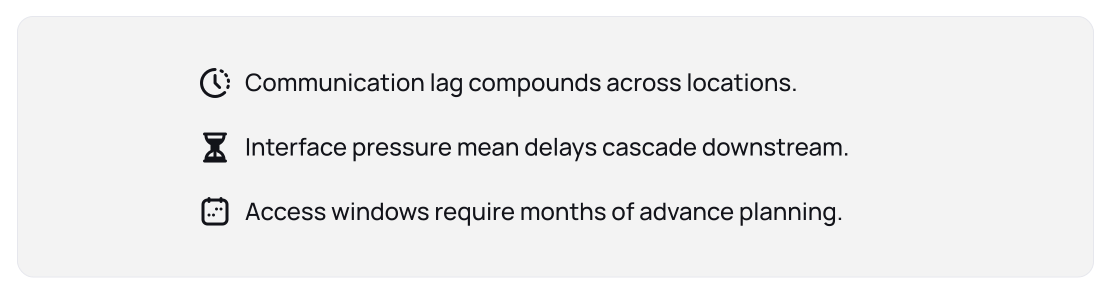
The result is projects in which site teams struggle to maintain up-to-date information across all locations while managing the constant pressure of interface dependencies and approaching possession deadlines.
Martinus' approach: Disciplined routines and collaborative culture
Martinus' approach was simple: create routines that make it easy for everyone to keep plans current and talk to each other, while building genuine relationships that help teams solve problems together.
The team understood that good coordination isn't really about sophisticated tools or processes. Instead, it requires clear routines, coupled with a culture that encourages people to raise issues early and work together to fix them before they compound.
It's all about culture. A disciplined, organised culture builds resilience. It means that when change does come, you can think on your feet, work through the problem, and move on.
Andrew Wiadrowski, Project Manager

Solution 1: Establish rigorous weekly planning cycles
The Martinus team made planning updates a weekly habit with clear ownership. Instead of treating updates as occasional paperwork, they assigned every engineer to keep their own scope current, with managers checking in on how things were tracking each week.
The magic was in looking not only at what went wrong, but also at why. This created accountability that didn't feel heavy-handed. When you know you'll be discussing your work every week, you naturally think harder about what you promise and what you need to coordinate to make it happen.
This weekly rhythm proved invaluable when surprises inevitably popped up. With 15 bridges in some of Sydney’s most built-up brownfield areas, the team constantly encountered previously unknown issues, including century-old water mains, structural problems, and gaps in the design. Because these problems were raised quickly in team discussions, the solutions could be engineered ahead of critical possession weekends when the work had to be completed.
My advice is to plan hard early and use that time to really nail down the details. Sometimes, if you have the opportunity, instead of kicking it down the road, just get started early. You never know what's in the ground until you start digging.
Andrew Ford, Senior Project Manager
How to implement with Aphex: Publishing routines and weekly reviews
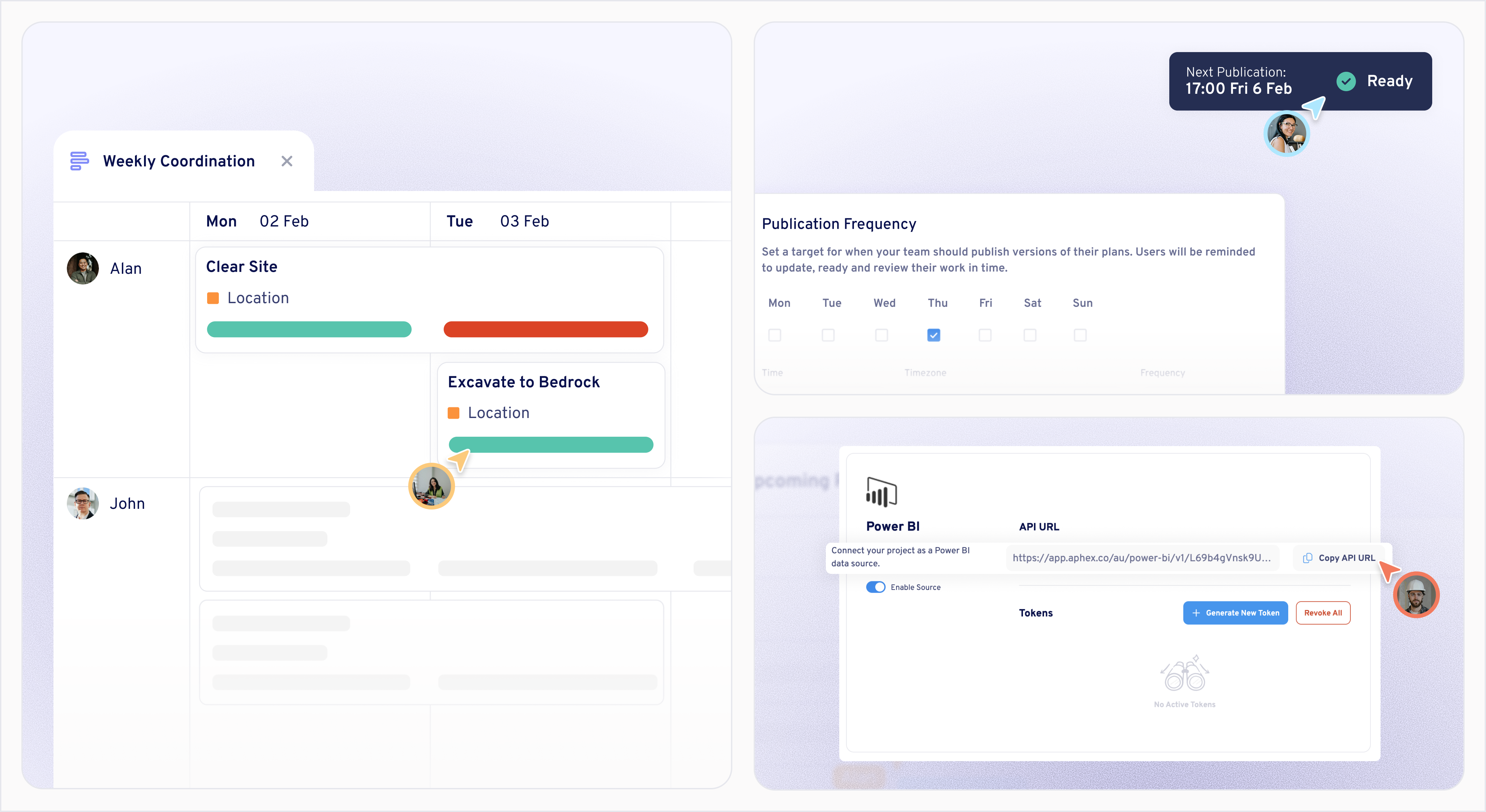
Establish a weekly planning cycle using Aphex's publishing feature to snapshot your plan, keeping everyone on current information for critical decisions. Pair this with a weekly review meeting powered by a PPC dashboard (via the Power BI integration) to turn status updates into concrete performance conversations.
Before publishing, have engineers use the "Make Ready" workflow to confirm their scope is accurate. This creates genuine accountability, not just admin. Over time, your publishing history becomes a clear record of how the plan evolved, making it easy to have honest conversations with clients and contractors when scope or circumstances change.
The PPC report was a very helpful part of Aphex. There's a lot of noise when you have so many different sites happening at once. Running the PPC dashboards every week gave a real snapshot of how we actually performed against our program.
Andrew Wiadrowski, Project Manager
Solution 2: Build collaborative relationships across interface boundaries
On Sydney Metro Southwest, instead of one or two main contractors handling different areas, the client brought in multiple contractors, each managing specific technical work across the entire alignment.
The Martinus team put serious effort into building good relationships with the other contractors and the client. Instead of treating every interface as a contractual line to defend, they saw them as coordination puzzles that required constant communication and people willing to help each other.
This investment paid off when issues inevitably arose. Existing relationships meant everyone could work together to find solutions rather than pointing to contracts and refusing to budge. Because the Martinus team consistently hit their commitments, other contractors trusted their program updates.
On a job like this with so many complex interfaces, my advice is to build relationships with all the interfacing parties so there's give and take and a collaborative approach.
Andrew Wiadrowski, Project Manager
How to implement with Aphex: Multiplayer planning and stakeholder communication
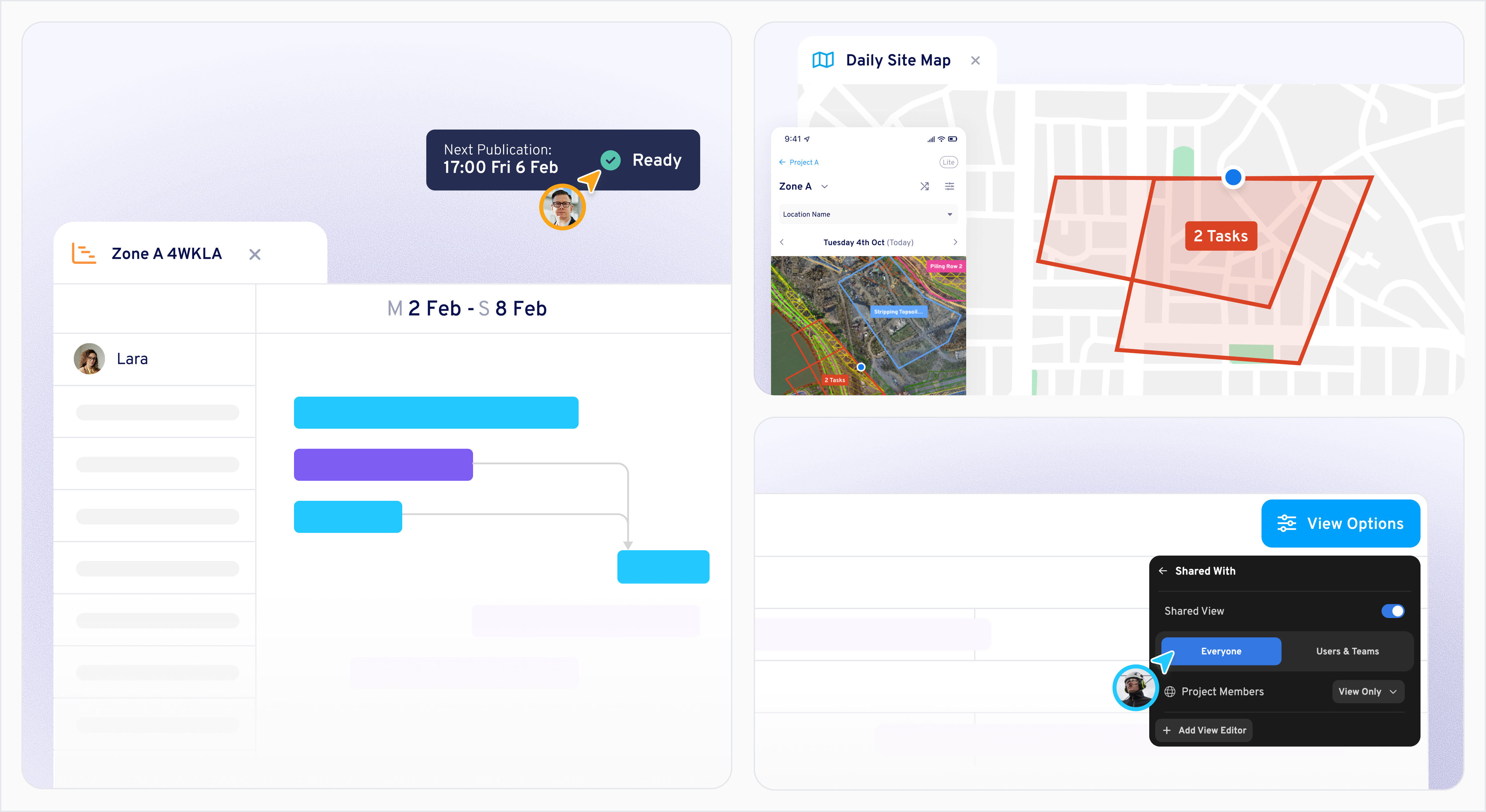
With Aphex, engineers across disciplines and trades see the same live information. This replaces the usual drift of separate spreadsheets and lets you spot clashes as they develop rather than when crews collide on site.
Give interface contractors and stakeholders ‘view access’ to relevant plan sections, so they can check the current status themselves instead of waiting for updates, reducing coordination meetings. Site engineers can own their sections directly. For stakeholders who prefer traditional formats, export and print functions let you generate clean, filtered views without maintaining separate documents that fall out of sync.
Aphex is much more intuitive for people who haven't used programming software. We've been able to utilise the younger engineers to update programs. They're the guys on the ground doing the work. This frees up the people above them to focus on delivery.
Andrew Ford, Senior Project Manager
The results: Maintaining delivery certainty through constant change
Martinus' approach to coordination delivered measurable improvements in both delivery certainty and team resilience throughout the project.
- On track to deliver without delaying interfaces. The team is on track to complete their scope without impacting other interface contractors or delaying the client's testing regime. This delivery certainty came from systematic coordination rather than hoping interfaces would work themselves out.
- Successfully adapted to constant change. The project faced design changes, scope additions, and latent conditions—such as the discovery of 100-year-old water mains requiring replacement. The team successfully absorbed these changes while maintaining program integrity.
- Maintained strong team culture and client relationships. The team maintained a strong internal culture and excellent relationships with interface contractors and the client.
While complex brownfield environments with extensive interface management will inevitably bring change, the team continues to successfully deliver our scope collaboratively with key interface stakeholders and to play our part in the key testing phases of the project. That's been a result of us delivering on time and doing what we said we're going to do.
Andrew Wiadrowski, Project Manager

What you can apply
- Establish disciplined planning routines early. Establish regular planning cycles with clear ownership, expected updates, and consistent review of performance against commitments. This discipline becomes particularly critical when managing work across multiple discrete locations with independent construction paths.
- Invest in relationships before you need them. The relationships you build during easy periods determine whether those problems get solved collaboratively or escalate into contractual disputes. Spend time building trust with interface contractors and stakeholders, and maintain that trust by delivering on your commitments.
- Give site teams ownership while maintaining accountability. On projects with multiple locations, centralising all planning through one or two people creates bottlenecks that prevent current information from reaching decision-makers. Provide tools that make it simple for site teams to take ownership while maintaining visibility for management review.

Heading
Lorem ipsum dolor sit amet, consectetur adipiscing elit. Suspendisse varius Duis cursus,