
On time, on budget, for everyone. Using Aphex, we've shown how successful a collaborative project can be and how it encourages the best work from everyone.


Major infrastructure projects are essentially coordination exercises. You have contractors, clients, subcontractors, and suppliers—all with their own systems, priorities, and ways of tracking work. Getting everyone aligned and keeping them that way is a fundamental challenge.
The usual pattern is familiar: the head contractor maintains the master program, subcontractors and site teams work from their own spreadsheets, suppliers manage deliveries separately, and the client gets periodic reports. This fragmentation often means coordination problems surface on-site rather than during planning, when you could actually do something about them.
How do major projects avoid these challenges to delivery? To learn more, we spoke with Andrew Tindal from the ACCIONA-Fulton Hogan joint venture on a major Queensland infrastructure project about how his team made their program the foundation of project delivery.
The infrastructure project
ACCIONA and Fulton Hogan formed a joint venture to deliver a major infrastructure project in Central Queensland, with stage one valued at approximately $120 million as part of a broader $700 million project.
The JV required careful coordination across multiple interfaces: working within existing road networks, managing traffic switches and lane closures, coordinating with various subcontractors and suppliers, and maintaining clear communication with the client throughout delivery.
Fulton Hogan brought extensive regional experience and established relationships, while ACCIONA contributed technical excellence in sustainable infrastructure solutions, along with recent project delivery capability in the area. Together, they assembled a young, adaptable team willing to try new approaches to program management and coordination.

Why coordination breaks down on multi-party projects
Infrastructure projects involving multiple contractors, subcontractors, and client stakeholders face coordination challenges that traditional planning methods struggle to address:
- Information silos create coordination gaps. Each party maintains separate plans that drift apart over time. The head contractor's program shows one view, subcontractors work from different information, and the client receives periodic snapshots that don't reflect the current reality.
- Resource visibility disappears across organisational boundaries. Equipment utilisation and labour allocation decisions occur within organisational boundaries, without visibility into broader project needs.
- Changes propagate slowly through communication chains. When subcontractors update their schedules or conditions change on site, information must flow through multiple communication steps before reaching all affected parties.
This results in coordination problems surfacing during execution rather than during planning, leading to reactive problem-solving rather than proactive management.
The ACCIONA-Fulton Hogan approach: Program-first coordination
This project’s solution centered on a fundamental principle: make the program the cornerstone of project delivery and ensure everyone—from project leadership through to site teams—always understands the current program state.
Rather than treating the program as a planning artifact to be periodically updated, the team made it a living coordination tool that captured the current reality and informed all decision-making. This required cultural commitment beyond just implementing new tools.
The breakthrough insight was that most coordination problems stem from people making reasonable decisions based on incomplete or outdated information. By ensuring all parties worked from the same up-to-date program, better coordination happened naturally without requiring constant management intervention.
Your program is the most important thing to get right. Get your program right first, and then you can forecast with confidence.
Andrew Tindal, Construction Manager, ACCIONA-Fulton Hogan JV
Establish a culture of continuous program updates
For this project, engineers continuously updated their own scopes as work progressed. This means that no one was waiting for scheduled reviews to update the program. Everyone could see the current state at any time, allowing the team to make decisions based on what was actually happening rather than last week's snapshot.
The key was to distribute ownership. Instead of a central planner maintaining everything, each engineer owned their own scope, meaning that the program always reflected site reality. When the team evaluated sequencing, managed traffic impacts, or coordinated with subcontractors, they worked from current information. The program became a live problem-solving tool rather than a static report.
The discipline extended to understanding why commitments moved. Rather than just noting delays, the team systematically captured reasons, building knowledge of what actually drove program variance and spotting recurring issues that needed systematic fixes.
Our main focus was on making sure everyone understood the program. We made that a cornerstone of our project and our planning.
Andrew Tindal, Construction Manager, ACCIONA-Fulton Hogan JV
How to implement with Aphex: Shared program management
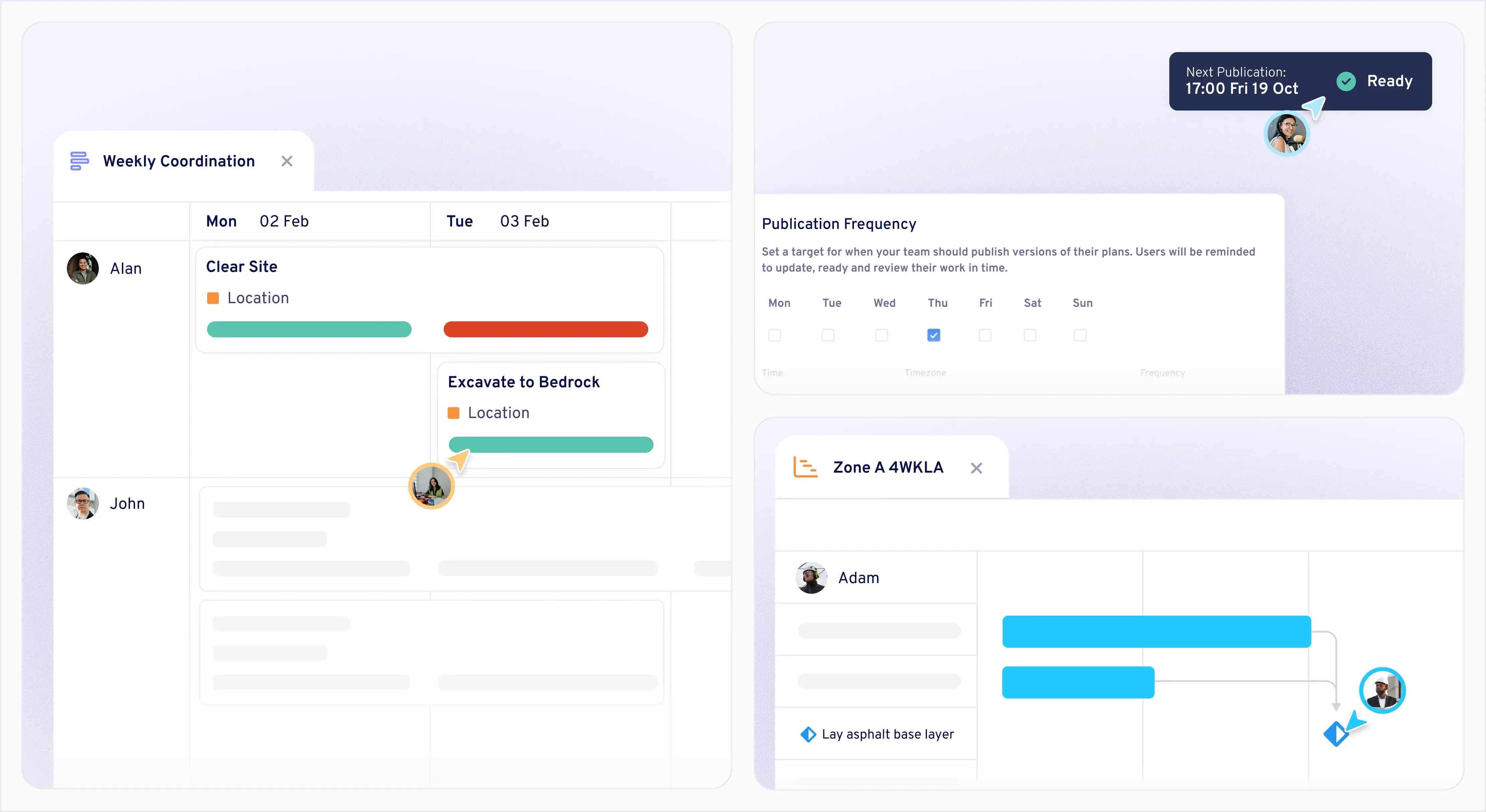
Create a single Aphex environment where all internal team members can contribute to program updates. Use Aphex's promise functionality to establish weekly commitment cycles. Engineers promise their upcoming work at the start of each week, creating clear accountability for delivery. When commitments shift, the system requires delay reasons that build a systematic understanding of program variance drivers.
Then, set up automated publishing routines that create timestamped program snapshots. These published versions give external parties—including the client—consistent visibility into program evolution without requiring direct system access. Regular publication creates a shared rhythm where all stakeholders expect and receive current information.
Leverage Aphex's milestone tracking to maintain visibility into critical interface points and client deliverables. As detailed program updates are provided, milestone dates are automatically adjusted, giving early warning when interface commitments may be at risk.
One of the most important features of Aphex is the use of milestones. They show how the program moves over a period of time, week to week, and records all the information about why these movements have taken place.
Andrew Tindal, Construction Manager, ACCIONA-Fulton Hogan JV
Coordinate directly with subcontractors in the program
Instead of asking subcontractors to maintain separate programs, engineers built and updated the single program in Aphex directly with the subbies. During coordination meetings, the engineer would update the program in real time, immediately seeing how the subcontractor's work fit with the rest of the project.
This killed the usual back-and-forth. No more building a program, sending it for review, getting feedback, adjusting, and repeating. They built it together, which meant coordination problems surfaced during planning rather than on-site.
The approach worked particularly well with suppliers like ready-mix concrete providers. Building supplier schedules directly into the program meant the team could spot resource conflicts—such as concrete volumes requiring double-booked plant capacity—and resolve them during planning rather than when placing orders.
How to implement with Aphex: Subcontractor views
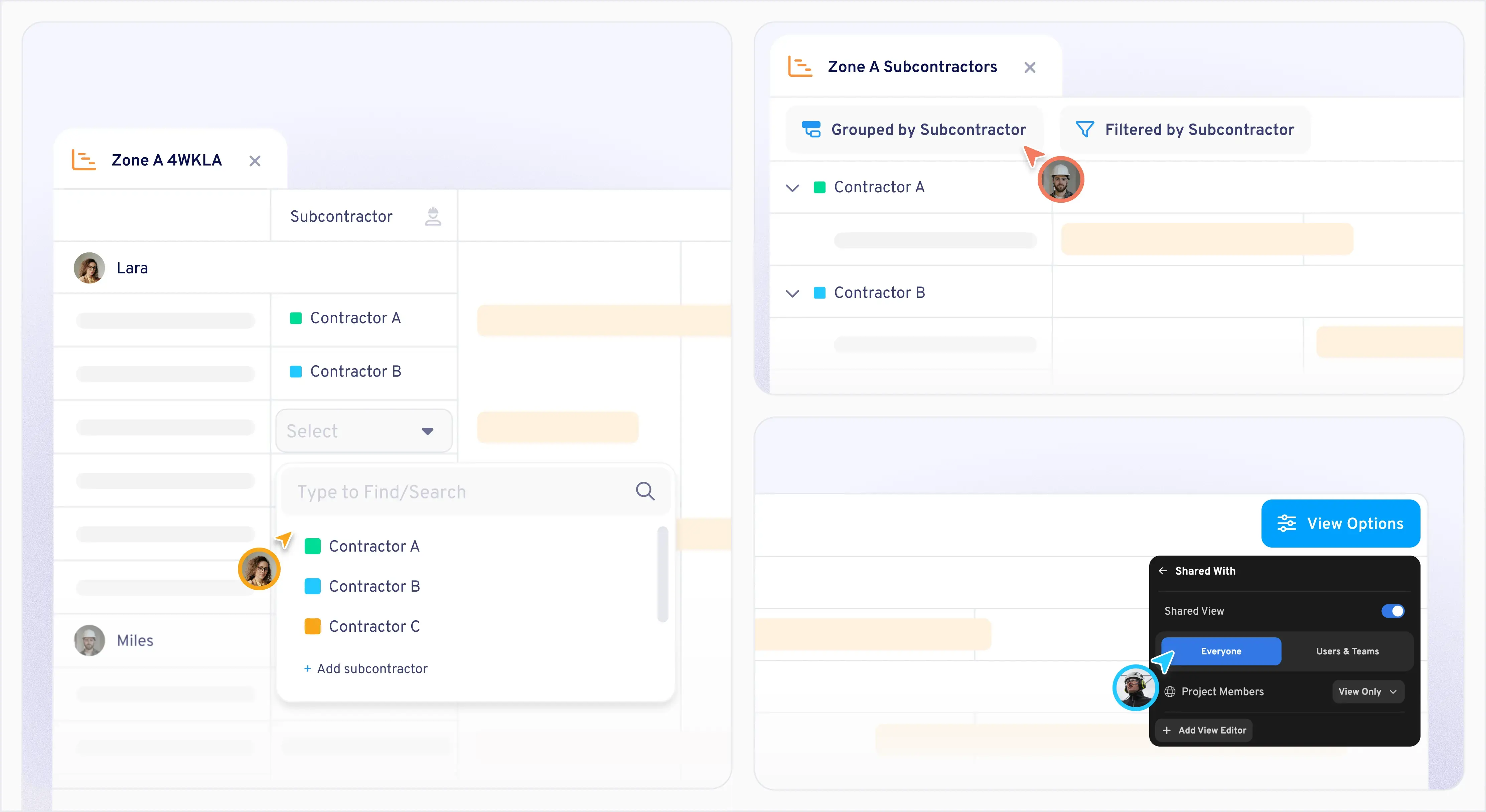
Use Aphex's subcontractor field to tag all activities by the executing party. This creates the foundation for automated subcontractor program views without requiring separate data management.
Create custom views filtered to specific subcontractors, showing only their relevant work across the whole project timeline. As engineers update the program, these subcontractor-specific views automatically reflect changes, providing current program information without manual consolidation.
Share these views with subcontractors either via direct access or regularly published exports. The key is ensuring subcontractors can see not just their own work but also the broader context, including what needs to happen before they can start, what depends on them completing, and where their work interfaces with others'.
Being able to use the subcontractor view means you're not having to collate programs. Everyone's operating in the same environment.
Andrew Tindal, Construction Manager, ACCIONA-Fulton Hogan JV
Maintain resource visibility in the program
Construction teams constantly wrestle with resource questions: How many graders does this project actually need? What ready-mix capacity is required when multiple pours overlap? These questions are hard to answer with confidence during planning, and by the time work starts, it becomes difficult to make adjustments.
The joint venture kept resource information—such as plant, materials, and labour—right in the program alongside activity timing. This meant they could see resource demand across the whole timeline and spot conflicts during planning rather than when resources failed to show up on site.
Because they updated resource requirements as the program evolved, the team could forecast demand weeks ahead. When concrete volumes ramped up across multiple areas, this became visible early, prompting conversations about supplier capacity before issues hit.
The visibility particularly helped with plant utilisation. Instead of guessing at equipment needs or discovering conflicts when crews competed for the same machinery, the program showed where everything was planned, supporting smarter mobilisation decisions.
With major infrastructure projects, you’ve got all these moving parts, and you're trying to maintain an even amount of resources. You're not trying to have too much variance from day to day or week to week. It’s critical to keep track of shifting demand across the entire project.
Andrew Tindal, Construction Manager, ACCIONA-Fulton Hogan JV
How to implement with Aphex: Resource planning and visualisation
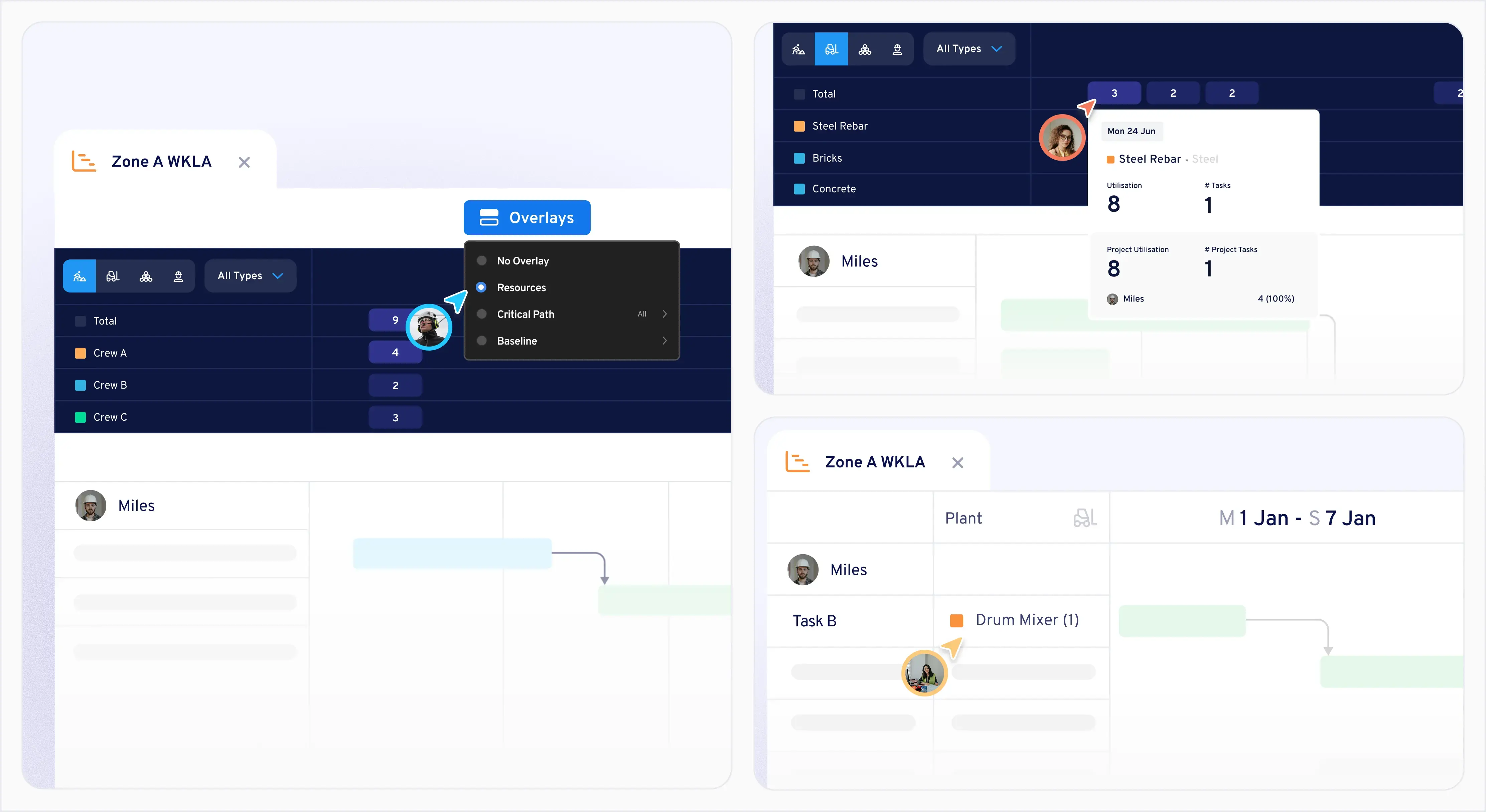
Set up resource categories in Aphex that match your actual project needs, such as specific plant items, material types, and specialised crews that drive real coordination decisions. Then, have engineers assign resource requirements as they build work sequences. This creates a natural connection between timing and resource demand without requiring separate data entry.
Once the team have added resource requirements, use Aphex's resource overlay to visualise demand across your timeline. When multiple activities compete for the same resources, it becomes immediately apparent, prompting coordination discussions before conflicts hit site.
How many graders did we actually need? How many were we planning to have working at the same time? In other projects, often no one can actually give you a straight answer. Aphex helped us make resource requirements clear to everyone across the project.
Andrew Tindal, Construction Manager, ACCIONA-Fulton Hogan JV
The results: Early delivery with client and commercial success
The ACCIONA-Fulton Hogan joint venture's program-first approach delivered measurable success across multiple dimensions of project performance. The team attributes these outcomes directly to their program-first coordination approach. By ensuring everyone worked from current program information, coordination problems were resolved during planning rather than disrupting execution.
Key results include:
- Project completion ahead of schedule. Stage one finished 3.5 months ahead of the contracted completion date.
- Commercial success. The project achieved financial success for both the joint venture partners and the client.
- Client satisfaction. The client expressed high satisfaction with project delivery.
On time, on budget, for everyone. This project has shown how successful a collaborative style project can be and how it encourages the best work from everyone.
Andrew Tindal, Construction Manager, ACCIONA-Fulton Hogan JV
What you can apply
- Make the program your project's focus. Most coordination problems stem from different parties working with different information about project timing and sequencing. Invest in maintaining a current, accessible program that all parties reference for decision-making rather than treating program updates as separate administrative exercises.
- Distribute program ownership throughout your team. Central planners can't maintain current program information when they're removed from daily work reality. Enable engineers and site teams to maintain their own scopes directly, creating accountability for program accuracy at the level where work actually happens.
- Work collaboratively with subcontractors on program development. Multiple iteration cycles between parties introduce delays and translation errors. Build programs directly with subcontractors during coordination discussions, immediately seeing interface requirements and resolving conflicts during planning.
- Track not just what happened, but why. Program variance is inevitable. Systematic capture of delay reasons builds understanding of what actually drives program performance, supporting better future planning and identification of recurring issues requiring systematic solutions.

Heading
Lorem ipsum dolor sit amet, consectetur adipiscing elit. Suspendisse varius Duis cursus,

.webp)



.webp)
